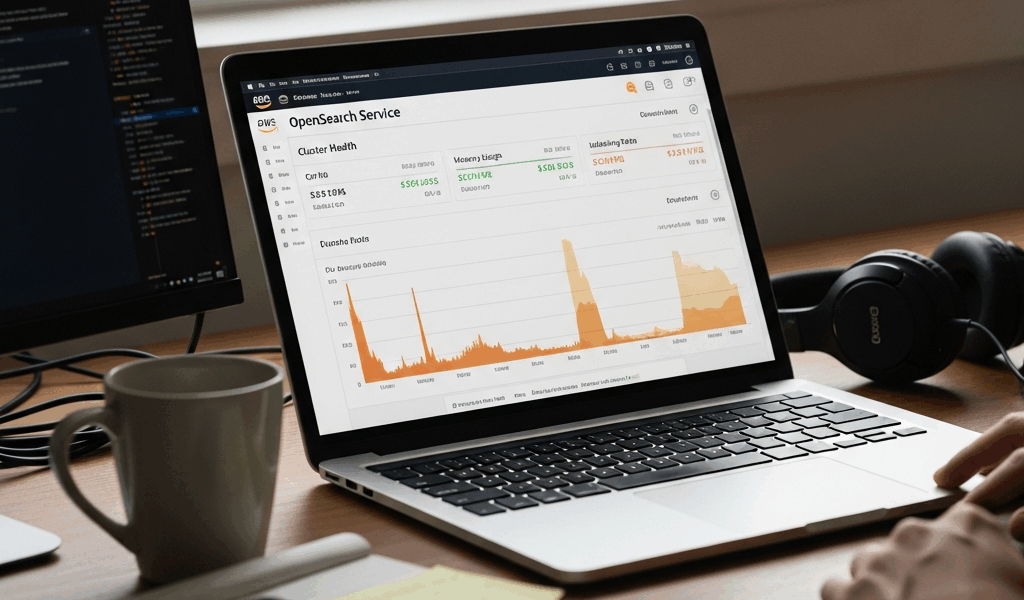
You need search functionality for your application and AWS gives you two OpenSearch options: managed OpenSearch Service clusters that you size, configure, and operate, or OpenSearch Serverless collections that AWS manages entirely. The pricing models are different, the operational burden is different, and choosing wrong means either overpaying for capacity you do not need or hitting scaling ceilings when your workload grows.
What OpenSearch Serverless Actually Is
OpenSearch Serverless removes the cluster management layer entirely. You create a collection, define an access policy, and start indexing data. There are no instances to size, no shard strategies to design, no node counts to tune. AWS handles scaling, patching, and capacity management behind the scenes.
The pricing unit is the OpenSearch Compute Unit (OCU) — a combination of compute and memory that scales automatically based on your workload. You pay for indexing OCUs and search OCUs separately, with a minimum of 2 OCUs for indexing and 2 for search (4 OCUs total minimum). At roughly $0.24 per OCU per hour, the minimum cost runs approximately $700 per month even if your workload is minimal. This minimum cost is the single most important fact in the decision.
Collections come in three types: search (for full-text search workloads), time series (for log analytics and metrics), and vector search (for ML-powered similarity search and RAG applications). Each type is optimized for its access pattern, and you choose at creation time.
What Managed OpenSearch Service Gives You
Managed OpenSearch Service is a traditional managed cluster. You select instance types, node counts, EBS storage volumes, and configure the domain. AWS handles the OpenSearch software, patching (on your schedule), and backups. You handle capacity planning, shard strategy, index lifecycle management, and performance tuning.
The operational burden is real but manageable. You need to understand shard sizing (target 10-50 GB per shard), monitor JVM memory pressure, plan for blue/green deployments during version upgrades, and right-size instances based on your query patterns. For teams with OpenSearch or Elasticsearch experience, this is familiar territory.
Pricing is instance-based. A small development cluster (single t3.small.search instance with 10 GB EBS) runs about $30 per month. A production cluster with three m6g.large.search data nodes, dedicated master nodes, and Multi-AZ costs $400 to $800 per month depending on storage. You have full control over costs because you control instance sizing.
When to Use OpenSearch Serverless
Unpredictable or spiky workloads. If your search traffic goes from 10 queries per second to 1,000 during peak hours and back to 10 overnight, Serverless scales automatically without you pre-provisioning capacity for the peak. With managed clusters, you either over-provision (paying for unused capacity) or risk performance degradation during spikes.
Teams without OpenSearch expertise. If nobody on your team has managed Elasticsearch or OpenSearch clusters, Serverless removes the operational learning curve entirely. No shard management, no JVM tuning, no capacity planning. The trade-off is cost and control — but avoiding a poorly configured managed cluster is worth a premium.
Vector search and RAG applications. OpenSearch Serverless vector collections provide purpose-built infrastructure for ML embedding storage and similarity search. If you are building a Retrieval-Augmented Generation pipeline or semantic search feature, the Serverless vector collection type is optimized for this workload and integrates cleanly with Amazon Bedrock and SageMaker endpoints.
Time series log analytics at scale. If you are ingesting high-volume logs (100GB+ daily) with variable query patterns, the time series collection type handles the ingestion scaling and retention lifecycle automatically. This is particularly useful for security analytics and compliance logging where ingestion rates are unpredictable and query patterns are bursty.
When to Use Managed OpenSearch
Predictable workloads where cost optimization matters. If your search workload is steady — consistent query volume, predictable data growth — a right-sized managed cluster is significantly cheaper than Serverless. The $700/month Serverless minimum buys a capable production managed cluster that handles substantial workloads.
Development and testing environments. A t3.small.search single-node cluster at $30/month versus the Serverless minimum of $700/month is not a close comparison for dev/test workloads. Use managed clusters for non-production environments unless your testing requires the Serverless-specific APIs and behavior.
Custom plugin requirements. Managed OpenSearch supports custom plugins and advanced index configurations that Serverless collections do not expose. If your workload requires specific analyzers, custom scoring functions, or plugin-based functionality, managed clusters are your only option.
Fine-grained index management. Managed clusters give you full control over index settings, shard allocation, index lifecycle policies, and cross-cluster search configurations. Serverless abstracts this away — which is the point for simplicity, but a limitation when you need precise control over how data is organized and queried.
The Decision in Practice
The simplest decision framework: if your monthly OpenSearch spend would be under $700 with a managed cluster, use a managed cluster — Serverless costs more at the low end due to the OCU minimum. If your workload is variable, your team lacks OpenSearch expertise, or you need vector search integration, Serverless removes operational burden at a premium. If you need both cost control and zero management, consider using managed clusters for steady workloads and Serverless collections for the spiky or specialized ones within the same application architecture.




Stay in the loop
Get the latest team aws updates delivered to your inbox.